
NDIS dictionary: breaking down the jargon

The National Disability Insurance Scheme (NDIS) can be really confusing, especially for people who haven't had an NDIS plan yet. Once you break through the NDIS jargon and technical terms you will start to understand your plan, how to use your allocated budget and can unlock the potential of your plan to achieve your goals. Of course, your plan manager can also help you with this.
NDIS
National Disability Insurance Scheme
NDIA
National Disability Insurance Agency, the government department that delivers the NDIS
LAC
Local Area Coordinators work for the NDIA to generate and authorise your plan.
Agency, Self or Plan Managed
Types of ways you can choose to manage your NDIS funding. Here is more detail about each type of money management.
AAT
Administrative Appeal Tribunal is where participants can go to appeal a decision made by the NDIA.
Funded Supports
Funded Supports are goods and services that the NDIS will pay for through your NDIS plan.
Informal Supports
An informal support is one that you receive from your family or a friend and or from other mainstream supports such as the education, mental health or health system. These are not paid for by the NDIS. For example, the NDIS in most circumstances won’t pay your grandmother to care for you or pay for medicine that should be paid for by the health system.
Registered Provider / Unregistered Provider
Registered providers have gone through the NDIS registration process and can be used by all NDIS participants.
Unregistered providers are those who have not gone through the NDIS registration process but can still be used by participants whose plans are self or plan managed.
Reasonable and Necessary Supports
NDIS pays for supports that are ‘reasonable and necessary’ which means that they need to meet the NDIS’s criteria and be related to your disability and not an everyday expense.
NDIS Pricing Arrangements and Price Limits
The NDIS Pricing Arrangements and Price Limits contains line item price limits that providers can charge NDIS participants and tells you what services you may be able to claim under support budget categories.
Budget Support Category
In your plan you will have different budget support categories to claim different services from. There are three types of budget support categories: core supports, capital supports and capacity building supports. Within these three types of supports there are 15 budget support categories.
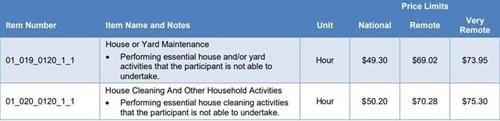
Line Item
A line item has a unique code, name/description of service and a unit/price. Your provider will pick a line item that reflects the service they are delivering to you. For example, if you’re using a cleaner they will claim using the House Cleaning and Other Household Activities line item.
Core supports
The core budget is funding to support all your assistance with day-to-day tasks that relate to your plan and life goals.
Capital supports
Capital supports is a budget that funds products and technology to reduce the impact your disability.
Capacity building
This budget pays for services to increase your capacity to undertake day-to-day tasks in all areas of your life.
More about How does NDIS funding work?
Recent posts
18 February 2026
28 January 2026
26 January 2026
29 September 2025
You may also like...

Your options if your NDIS access request is rejected
What happens if your NDIS access decision doesn’t go your way? We explore next steps and options.
The true cost of caring
Informal carers have an enormous and positive impact on the nation. But at what cost?
Consent and the NDIS
If you’re a participant in the NDIS, before anyone can see information about you or make decisions on your behalf, they need your consent.
Psychosocial disability explained
The term ‘psychosocial disability’ can be misunderstood or confusing to those who’ve never heard of it. So, what does it mean?